

FOR ENGLISH-SPEAKING PARTICIPANT
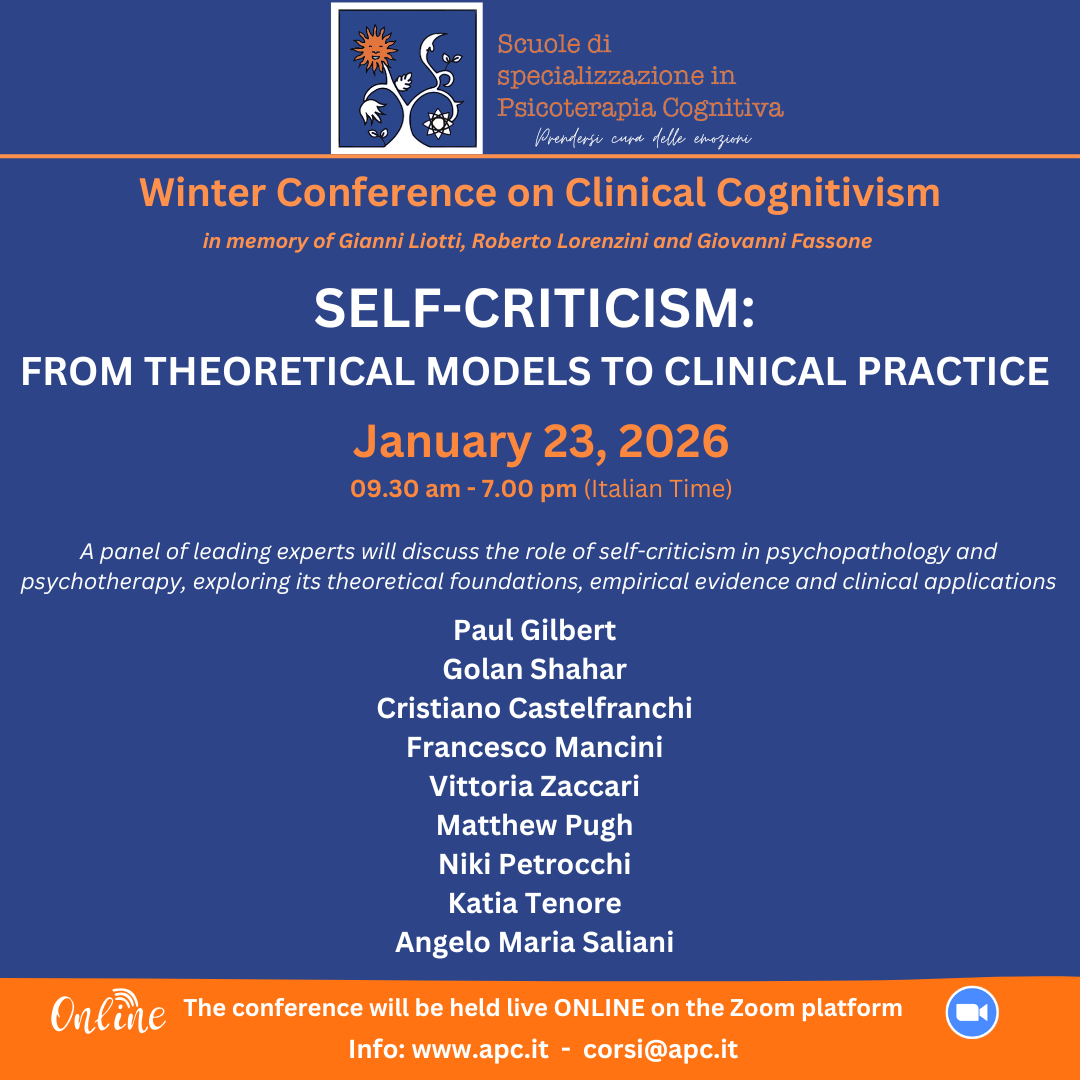
Winter Conference on Clinical Cognitivism
in memory of Gianni Liotti, Roberto Lorenzini and Giovanni Fassone
SELF-CRITICISM:
FROM THEORETICAL MODELS TO CLINICAL PRACTICE
23 Gennaio 2026
09.30 am – 7.00 pm (Italian Time)
A panel of leading experts will discuss the role of self-criticism in psychopathology and
psychotherapy, exploring its theoretical foundations, empirical evidence and clinical applications
Paul Gilbert
Golan Shahar
Francesco Mancini
Vittoria Zaccari
Matthew Pugh
Niki Petrocchi
Katia Tenore
Angelo Maria Saliani
The conference will be held live ONLINE on the Zoom platform
For Italian interventions, a simultaneous interpretation service in English is provided.
It will only be possible to participate in the Summit live
FREE REGISTRATION
for foreign language participants (NOT Italians)
Participation is free, but registration is required.
Fill out the online registration form at the bottom of this page
INFO: corsi@apc.it
PRESENTATION
Self-criticism is one of the transdiagnostic factors that has generated growing interest in
recent years, both in the scientific literature and in clinical practice.
Several authors have developed authoritative theoretical models, exploring its implications
in psychopathology and psychotherapy. It represents a central element in various
disorders, contributing to their development and maintenance, and is considered a
negative prognostic factor in psychotherapy.
On the occasion of the 2026 Winter Conference for Clinical Cognitivism, organized by the
Network of Cognitive Psychotherapy Training Schools, a group of internationally renowned experts will discuss the role of self-criticism in psychopathology and psychotherapy, examining its theoretical foundations, clinical applications, and presenting specific therapeutic approaches aimed at its treatment.
The Conference will offer numerous contributions integrating theoretical, empirical, and
clinical perspectives.
It will be divided into two parts: the first will focus on theoretical aspects and empirical findings in the field, while the second will have a more practical and experiential nature, emphasizing therapeutic techniques and procedures for addressing self-criticism (Chairwork, Compassion-Focused Therapy, Schema Therapy).
The Conference represents a valuable opportunity to explore up-to-date theoretical and
clinical perspectives, fostering an open dialogue between theory, research, and therapeutic
practice.
SPEAKERS
Prof. Paul Gilbert
Clinical Psychologist and PhD, Professor of Clinical Psychology at the University of Derby. For over forty years, alongside his clinical work as a Consultant Clinical Psychologist in the UK National Health Service, he has carried out extensive research on evolutionary approaches to mental health. He is internationally recognized as one of the leading authorities on self-criticism, to which he has dedicated an important theoretical contribution and numerous studies examining its impact on mental health. He is the founder and developer of Compassion Focused Therapy (CFT) and, in 2006, established the
Compassionate Mind Foundation, which promotes well-being through the scientific dissemination and application of compassion. Author of numerous books, scientific articles, and book chapters, he has highlighted the central role of compassion in understanding and alleviating psychological suffering, with particular attention to the function of self- criticism in processes of distress.
Prof. Golan Shahar
Clinical Psychologist and PhD, Professor of Clinical and Developmental Psychology at Ben-Gurion University of the Negev in Israel, where he directs the Stress, Self & Health Lab. He also serves as Visiting Professor of Psychiatry at the Yale University School of Medicine and is an affiliated member of the Edward Zigler Center in Child Development and Social Policy. He is the author of numerous scientific publications and book chapters in the fields of personality, stress, psychopathology, psychosomatics, and psychotherapy. He has published a volume with Oxford University Press in which he presents an innovative theory of self-criticism and criticism-based relationships. His clinical and research work focuses on stress,
psychopathology, psychosomatic conditions, and resilience, with particular attention to adolescence, early adulthood, and the role of self-criticism in psychological disorders, an area in which he is an internationally recognized authority.
Prof. Francesco Mancini
Child Neuropsychiatrist and Psychotherapist. Director of the Schools of Cognitive Psychotherapy within the Italian Association of Cognitive Psychology (APC) and the School of Cognitive Psychotherapy (SPC). Lecturer and trainer in the APC, SPC, Italian Association of Cognitive Psychotherapy (AIPC), Italian School of Clinical Cognitivism (SICC), and Gabriele Buccola Institute (IGB). Teaching member of the Italian Society of Behavioral and Cognitive Therapy (SITCC). He is Full Professor at Guglielmo Marconi University in Rome, where he teaches Clinical Psychology. President of the Council of Italian Schools of Cognitive and Behavioral Psychotherapy. Author of numerous books and scientific publications at national and international levels, he has made pioneering contributions to the study of Obsessive-Compulsive Disorder, focusing particularly on guilt, cognitive processes in psychopathology, and the relationship between cognition and emotion.
Dr. Vittoria Zaccari
Psychologist and psychotherapist. Lecturer in Developmental Psychology at Guglielmo Marconi University in Rome. She conducts clinical and research activities at the clinical center of the cognitive psychotherapy schools APC and SPC in Rome. Member of the Italian Society of Behavioral and Cognitive Therapy (SITCC). She is the author of publications in national and international scientific journals and book chapters on topics such as psychopathology, therapeutic interventions, and the relationship between cognitive processes, emotions, and morality. Her current research focuses on the role of self-criticism in psychopathology, both theoretically and empirically, in its expression across different clinical profiles and therapeutic interventions.
Dr. Matthew Pugh
Clinical Psychologist, Cognitive-Behavioral Psychotherapist, Advanced Schema Therapist, Voice Dialogue facilitator, researcher, and trainer. He is Clinical Resources Lead at Psychology Tools and co-lead of the Cognitive-Behavioral Therapy program for Eating Disorders at University College London. Previously, he worked as lead therapist in one of the UK’s largest NHS outpatient services for eating disorders. An expert in chairwork, he has been conducting national and international training on this approach for years, contributing significantly to its dissemination in psychotherapy, coaching, and supervision. He has published numerous articles on the subject and is the author of the book Cognitive Behavioural Chairwork: Distinctive Features. He currently practices clinically in Buckinghamshire.
Dr. Niki Petrocchi
Psychologist, Psychotherapist, and PhD. She is a Psychology faculty member at John Cabot University in Rome, where she also provides student counseling services. She earned her PhD in Psychology and Social Neuroscience at Sapienza University of Rome and was a visiting scholar at Boston University. She trained with and collaborated for several years with Paul Gilbert. She is an accredited therapist and trainer in Compassion Focused Therapy (CFT) at national and international levels and founded Compassionate Mind Italia, the Italian association for CFT research, training, and dissemination. Her research focuses on the physiological correlates of prosocial motivation and the activation of compassion for oneself and others as a tool to overcome pathological self-criticism and promote psychophysiological well-being. She is author of numerous scientific publications and book chapters at national and international levels.
Dr. Katia Tenore
Psychologist, Psychotherapist, and PhD. She conducts clinical, teaching, and research activities at the cognitive psychotherapy schools APC and SPC in Rome. Founding member of the Italian Academy of Schema Therapy (IAST), she is a Trainer and Supervisor accredited by the International Society of Schema Therapy (ISST), as well as a teaching member of the Italian Society of Behavioral and Cognitive Therapy (SITCC). She is the author of numerous publications in national and international scientific journals, with a particular focus on psychopathology, therapeutic interventions—especially Schema Therapy—and the relationship between cognitive processes and emotions.
Dr. Angelo Maria Saliani
Psychologist and Psychotherapist. He conducts clinical and research activities at the clinical center of the cognitive psychotherapy schools APC and SPC in Rome. Lecturer and trainer at APC, SPC, SICC, and AIPC. Teaching member of the Italian Society of Behavioral and Cognitive Therapy (SITCC), he is a board member of the Italian Obsessive-Compulsive Disorder Association (AIDOC). He has previously served as Professor of Psychological Interview Techniques and Clinical Psychology at the University of L’Aquila. Author of publications in national and international scientific journals and book chapters. His clinical and research work focuses on cognitive-interpersonal cycles, relational and family problems in Obsessive-Compulsive Disorder, the regulation of the therapeutic relationship, and clinical interviewing techniques. He has devoted particular attention to cognitive restructuring procedures based on Socratic dialogue, including in combination with chairwork. His current research interests concern the role of self-criticism in Obsessive Compulsive Disorder and the development of specific therapeutic interventions.
PROGRAM
Friday, 23 Gennaio 2026 – 9:30 a.m. – 1:30 p.m. / 2:45 p.m. – 7:00 p.m. (Italian Time)
Chair: Vittoria Zaccari
09.30-09.45 am Introduction – The Role of Self-Criticism in Psychopathology
and Psychotherapy – Vittoria Zaccari
09.45-10.45 am The role of shame, self-criticism, and self-compassion in
psychopathology – Paul Gilbert
10.45-11.45 am Maintenance of Self-Critical Vulnerability: A Novel Theory – Golan Shahar
11.45-12.00 am – BREAK
12.00 am -1.30 pm From the Ideal Self to the Moral Self: Towards a New Model of Self-Criticism Integrating Moral and Non-Moral Judgment Criteria – Francesco Mancini & Vittoria Zaccari
1.30-2.45 pm – LUNCH BREAK
2.45-3.45 pm Bringing therapy to life through Chairwork: Interviewing the inner critic – Matthew Pugh
3.45-4.45 pm Silencing the Inner Critic: Chairwork Techniques to Confront the Parent Modes – Katia Tenore
4.45-5.00 pm – BREAK
5.00-6.00 pm Treating Guilty and Critical Self-Talk in OCD with Dramatized Socratic Dialogue – Angelo Maria Saliani
6.00-7.00 pm From Threat to Care: Experiential and Imagery-Based Techniques
of Compassion Focused Therapy for Self-Criticism – Niki Petrocchi
The Conference will be held ONLINE as a Webinar on the ZOOM platform
Friday, January 23rd, 2026, from 9:30 a.m. to 7:00 p.m.
Participation will be possible live only.
A simultaneous Italian/English translation will be provided.
The Conference is open to Psychology and Medicine students, graduating students, recent graduates, Psychologists, Medical Doctors, Psychotherapists, Psychiatrists, and Residents.
FREE REGISTRATION
for foreign language participants (NOT Italians)
Participation is free, but registration is required.
Fill out the online registration form at the bottom of this page.
INFO: corsi@apc.it – +393473566781
Prenotazioni
Le prenotazioni sono chiuse per questo evento.